
I used to think the best way to prepare for coding interviews was by solving as many problems as possible. After jumping between random questions for weeks, I realized I was getting better at recognizing specific answers instead of improving my overall problem-solving ability.
I also noticed that the biggest improvements came once I followed a structured plan. Rather than chasing difficult questions every day, I focused on learning one concept at a time. That steady approach built confidence, reduced frustration, and made technical interviews feel much less intimidating.
Why a Roadmap Beats Random Practice

Many candidates spend months solving hundreds of coding questions but still struggle during interviews. The reason is simple. Interviews don’t test how many problems you’ve memorized. They evaluate how you analyze a new challenge, explain your thinking, and arrive at a practical solution.
A structured coding interview preparation roadmap helps you build skills in the right order. Each concept supports the next one, making advanced topics easier to understand. Instead of constantly feeling stuck, you develop pattern recognition that carries across different question types.
Progress should also be measured by confidence with concepts, not by the number of completed problems. If you can explain why your solution works, compare its time complexity, and discuss alternatives, you’re moving in the right direction.
Build Strong Programming Fundamentals First
Choose one programming language and stick with it throughout your preparation. Whether you prefer Python, Java, or C++, becoming comfortable with syntax, standard libraries, and built-in data structures matters far more than switching languages.
Before tackling complex interview questions, understand how Big O notation measures time and space complexity. Interviewers often ask why one solution performs better than another, so learning to explain O(N), O(log N), or O(N²) is just as valuable as writing correct code.
It’s also worth understanding recursion limits, hashing, and how variables behave in memory. These fundamentals make debugging easier and help you write cleaner solutions under pressure.
Master Data Structures Before Advanced Algorithms

The next stage focuses on recognizing common problem patterns rather than memorizing answers.
Start with arrays and strings since they appear frequently in technical interviews. Practice traversing arrays, reversing strings, and working with two-dimensional matrices.
Then move into powerful optimization techniques like the Two Pointers and Sliding Window patterns. These often reduce brute-force solutions into efficient linear-time approaches.
Linked lists teach careful pointer manipulation, while stacks and queues strengthen your understanding of ordered processing. Spend time learning monotonic stacks because they appear in several medium-level interview questions.
Rather than solving fifty unrelated problems, spend a week mastering one pattern until recognizing it becomes almost automatic.
Expand Into Trees, Graphs, and Dynamic Programming
Once linear data structures feel comfortable, transition into hierarchical structures.
Binary Trees and Binary Search Trees introduce recursive thinking through preorder, inorder, and postorder traversals. Practice writing both recursive and iterative solutions because interviews may ask for either.
Heaps become useful when solving top-K element problems, while graphs introduce Breadth-First Search and Depth-First Search for exploring connected data efficiently.
Backtracking teaches systematic exploration through combinations, subsets, and permutations. Although these problems initially seem difficult, they become manageable after understanding the underlying recursive framework.
Finally, move into optimization topics like greedy algorithms, interval problems, and dynamic programming. Classic challenges such as Coin Change, Knapsack, and Longest Common Subsequence help develop a deeper understanding of breaking large problems into smaller overlapping subproblems.
These advanced topics require patience. Focus on understanding why each solution works instead of memorizing code line by line.
Strengthen Skills Beyond Coding Questions

Strong interview candidates don’t rely on algorithms alone.
Continue building small applications using Git and GitHub while reviewing object-oriented programming, databases, operating systems, and computer networks. These subjects often appear during technical discussions, especially for entry-level software engineering roles.
Working on real projects also demonstrates that you can apply programming concepts outside coding platforms. It naturally supports engineering mindset development, because building software involves planning, debugging, collaboration, and continuous improvement rather than simply passing interview questions.
A balanced preparation strategy makes you a stronger engineer, not just a stronger interview candidate.
Practice Like You’re Already in the Interview
The final stage should resemble the interview itself.
Use a 45-minute timer when solving medium-level problems. Learn to explain your thought process while coding instead of remaining silent. Interviewers often evaluate communication as carefully as they evaluate correctness.
Before considering a solution complete, test edge cases such as empty inputs, duplicate values, large datasets, and negative numbers. This habit catches mistakes that many candidates overlook.
Mock interviews are equally valuable. Practicing with peers or interview platforms helps you become comfortable thinking clearly while under pressure. The more realistic your practice sessions become, the less intimidating actual interviews feel.
A Practical 10 to 12 Week Roadmap
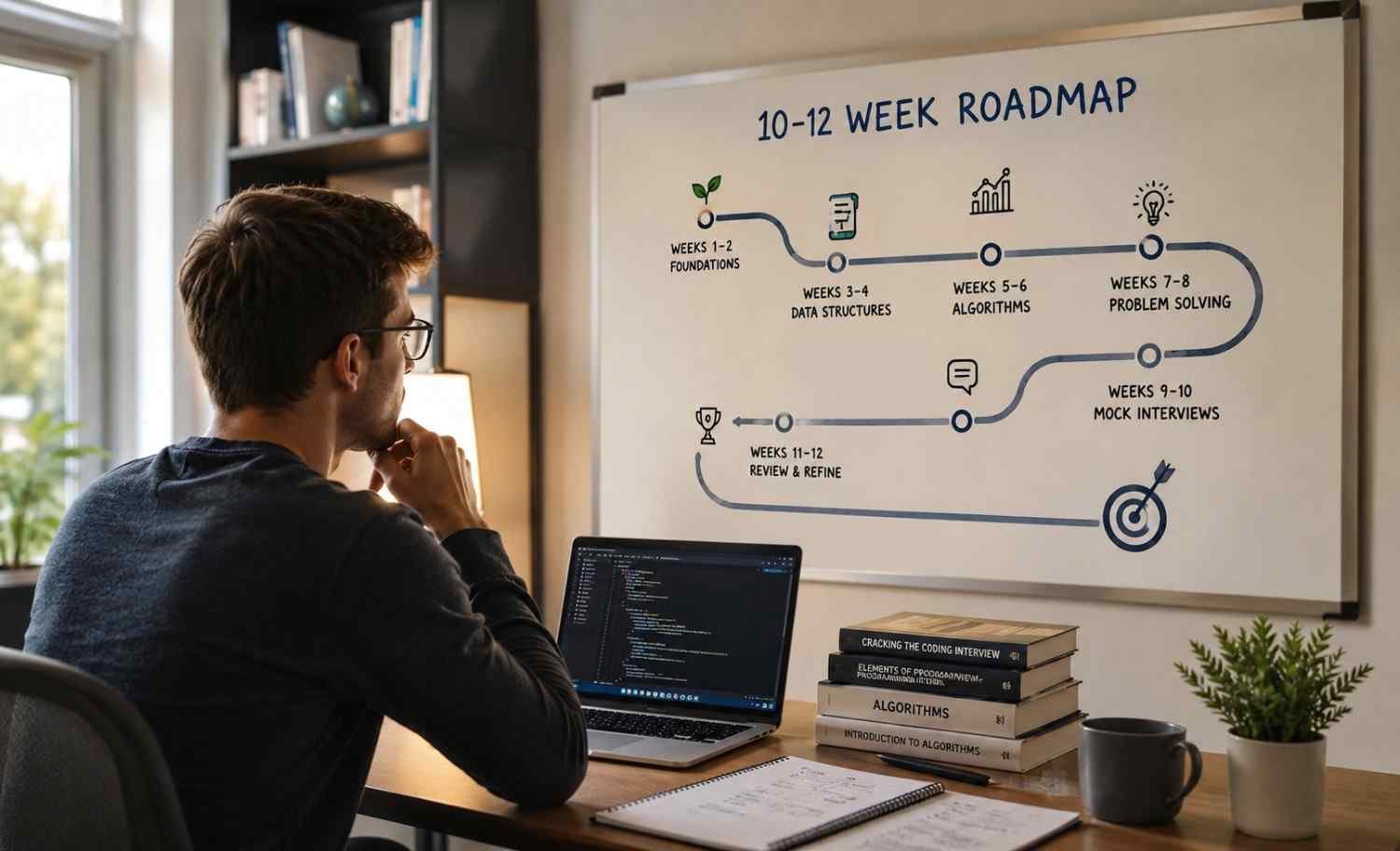
The first week should focus on mastering one programming language, reviewing Big O notation, and strengthening core programming fundamentals.
Weeks two through four should cover arrays, strings, linked lists, stacks, queues, sliding window techniques, and two-pointer patterns.
Weeks five through seven are ideal for studying trees, heaps, graphs, recursion, and backtracking.
During weeks eight and nine, dedicate time to greedy algorithms, intervals, and dynamic programming.
From week ten onward, prioritize timed practice, mock interviews, communication skills, and regular revision. By this stage, your goal shifts from learning new topics to consistently applying everything you’ve practiced.
FAQs: Coding Interview Preparation Roadmap From Basics to Confident Problem Solver
1. How long should I prepare for coding interviews?
A focused 10 to 12-week plan is enough for many candidates if they study consistently and practice regularly.
2. Should I solve hundreds of coding problems?
Quality matters more than quantity. Understanding patterns and explaining solutions provides greater long-term benefits than memorizing large numbers of questions.
3. Which programming language is best for interviews?
Python, Java, and C++ are all excellent choices. Pick one language and become highly comfortable with its syntax and libraries.
4. Are mock interviews really necessary?
Yes. They improve communication, time management, and confidence while exposing weaknesses before real interviews.
Why Consistency Creates Confident Problem Solvers
Successful interview preparation isn’t about finding shortcuts or finishing every coding platform. It’s about steadily building a foundation that allows you to recognize patterns, communicate clearly, and solve unfamiliar problems with confidence. Each week of focused practice strengthens skills that extend far beyond technical interviews and into real software development.
Stay consistent, trust the process, and let steady progress become your greatest advantage.
Leave a Reply