
I started noticing something interesting while talking to engineering students and new graduates. The people who stood out weren’t always the ones with the highest grades or the longest list of programming languages. They approached problems differently. Instead of looking for the fastest answer, they were curious enough to ask why the problem existed in the first place.
I also realized that developing an engineering mindset wasn’t something that happened after earning a degree. It grew through experience, small mistakes, and the willingness to keep improving. The more I observed successful engineers, the clearer it became that their greatest strength wasn’t memorizing formulas. It was learning how to think through challenges from multiple angles.
What Engineering Mindset Development Really Means

Engineering mindset development goes beyond technical knowledge. It is the ability to approach problems with curiosity, logic, and a willingness to test ideas until a practical solution emerges. While technical skills remain essential, the mindset behind those skills often determines how effectively they are applied.
A strong engineering mindset combines systematic thinking with creativity. Instead of jumping to conclusions, engineers define the problem, identify constraints, evaluate possible solutions, and refine their ideas based on evidence. This structured approach allows them to tackle everything from software bugs to infrastructure projects with confidence.
Another important characteristic is systems thinking. Rarely does one decision affect only one component. Every choice can influence cost, performance, usability, sustainability, and long-term maintenance. Seeing those connections helps engineers make smarter decisions throughout a project’s lifecycle.
Why Technical Knowledge Alone Isn’t Enough
College courses provide the foundation, but real-world engineering introduces uncertainty that textbooks cannot fully prepare students for.
Projects often involve limited budgets, changing requirements, unexpected technical challenges, and collaboration with people from different backgrounds. Success depends on adapting to these situations rather than simply recalling information.
Employers increasingly value engineers who communicate clearly, ask thoughtful questions, and work effectively in teams. Someone who can explain complex technical concepts to non-technical stakeholders often becomes just as valuable as someone with exceptional coding or design skills.
The ability to keep learning also matters. Technologies, programming languages, manufacturing methods, and industry standards continue evolving. Engineers who stay curious remain relevant throughout their careers instead of relying solely on what they learned in school.
The Core Habits Behind Engineering Mindset Development
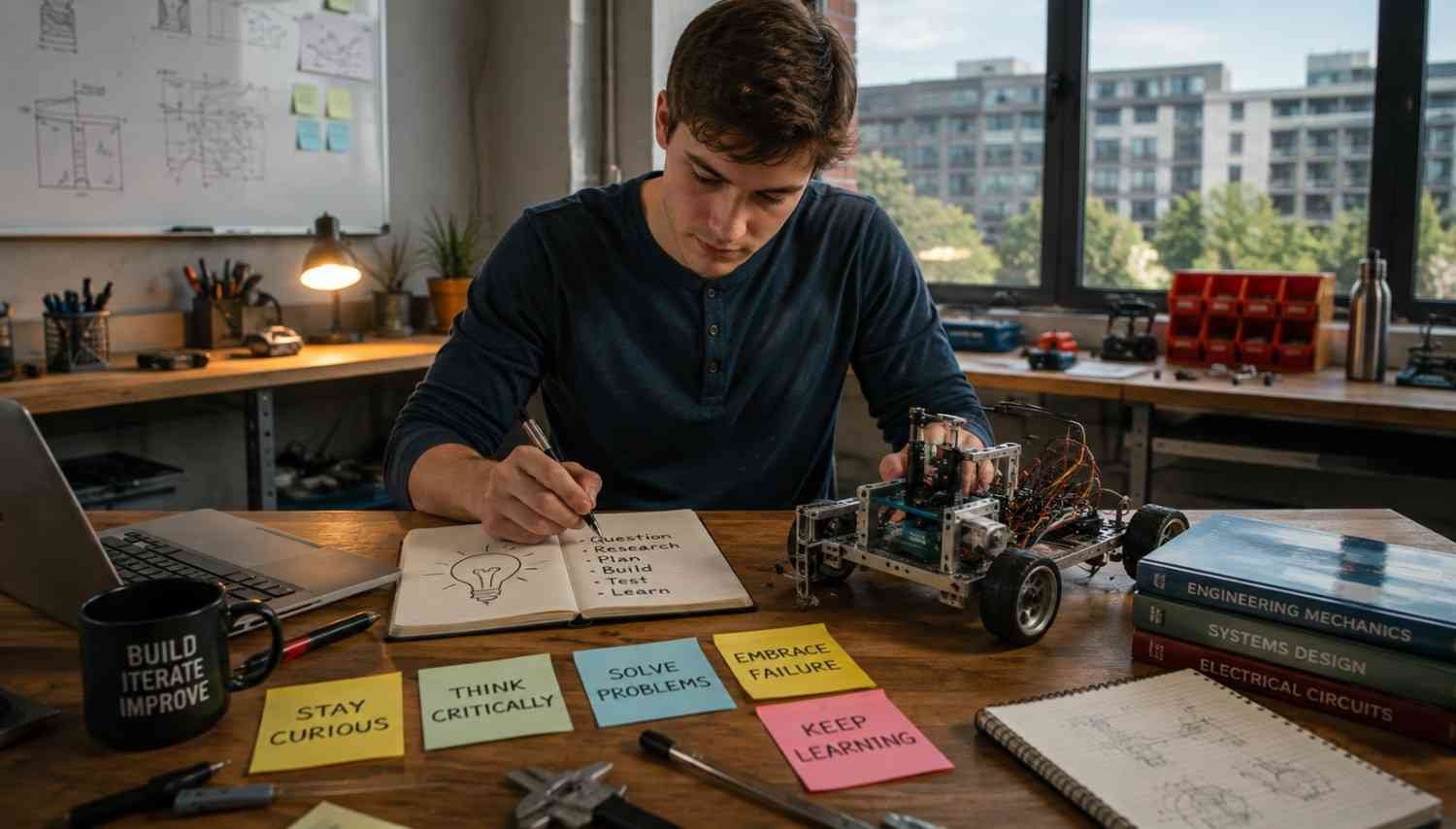
Building this mindset happens through repeated practice rather than one major breakthrough.
Follow a Structured Design Process
Every successful engineering project starts with understanding the problem before searching for solutions. Define the objective, identify constraints, brainstorm possibilities, build prototypes, evaluate results, and improve through multiple iterations.
This process prevents wasted effort and encourages better decision-making throughout the project.
Think in Systems Instead of Individual Parts
Every component interacts with something else.
A software feature affects user experience. A mechanical design influences manufacturing costs. A material choice impacts durability and sustainability.
Looking at the bigger picture leads to solutions that perform well beyond their immediate purpose.
Accept Constraints Instead of Fighting Them
Engineering rarely happens under perfect conditions.
Budgets, deadlines, regulations, available materials, and customer expectations all influence design decisions. Rather than viewing constraints as obstacles, experienced engineers treat them as design parameters that encourage smarter solutions.
Learn by Building, Not Just Reading
One of the fastest ways to strengthen engineering thinking is through hands-on experience.
Joining robotics clubs, participating in design competitions, contributing to open-source software, or building personal hardware and software projects exposes students to challenges that classroom exercises cannot fully replicate.
Working on real projects teaches lessons that are difficult to learn from lectures alone. Unexpected failures, changing requirements, debugging sessions, and teamwork all contribute to stronger problem-solving skills.
Even small projects can create meaningful learning opportunities. Designing a simple mobile application, automating a repetitive task, building an Arduino project, or creating a personal website all require planning, testing, troubleshooting, and continuous improvement.
The goal isn’t building something perfect. It’s learning how ideas evolve through experimentation.
Treat Failure as Valuable Feedback

One of the biggest differences between experienced engineers and beginners is how they respond when something doesn’t work.
Failed prototypes, unsuccessful experiments, and unexpected bugs are rarely signs of failure. Instead, they provide valuable information about what should change next.
Every iteration improves understanding.
Instead of asking, “Why did this fail?” effective engineers often ask, “What did this teach us?”
This shift in perspective encourages resilience and reduces the fear of making mistakes. Over time, each setback becomes another opportunity to improve both technical skills and decision-making.
Solve Problems That Have Real Context
Abstract exercises help build technical foundations, but real-world challenges develop stronger engineering instincts.
Projects connected to environmental sustainability, healthcare, accessibility, transportation, education, or business operations introduce practical constraints that require balancing multiple priorities.
These experiences also strengthen communication skills because technical solutions must satisfy users, stakeholders, and project goals rather than simply meeting technical specifications.
Working with real people often reveals challenges that cannot be predicted during initial planning.
Reflect After Every Project

Finishing a project should never mark the end of the learning process.
Take time to evaluate what worked well, what slowed progress, and what could be improved next time.
Questions such as these encourage continuous improvement:
- Which decisions produced the best results?
- What assumptions turned out to be incorrect?
- Where did communication break down?
- How could testing have started earlier?
- Which skills need further development?
Reflection transforms individual experiences into long-term professional growth.
Engineering Mindset Development Is a Career-Long Process
An engineering mindset isn’t something students master before graduation. It continues evolving throughout internships, first jobs, leadership roles, and every project that introduces unfamiliar challenges.
The engineers who continue growing are usually the ones who remain curious, ask thoughtful questions, collaborate openly, and never assume they already know everything. Technology will continue changing, but the ability to think systematically, adapt quickly, and solve meaningful problems will remain valuable regardless of the tools being used.
FAQs: Engineering Mindset Development for Students and Early Career Professionals
1. What is engineering mindset development?
Engineering mindset development is the process of building structured problem-solving, critical thinking, adaptability, and systems thinking that help engineers solve real-world challenges effectively.
2. Why is an engineering mindset important for students?
It prepares students to apply classroom knowledge to practical situations while improving teamwork, communication, and decision-making skills valued by employers.
3. Can engineering mindset development happen outside the classroom?
Yes. Personal projects, internships, robotics clubs, hackathons, research opportunities, and open-source contributions all strengthen engineering thinking through practical experience.
4. How long does it take to develop an engineering mindset?
It develops gradually through continuous learning, hands-on practice, reflection, and repeated exposure to increasingly complex engineering challenges.
Why the Way You Think Will Outlast Any Technology
Programming languages, engineering software, and technical tools will continue changing throughout your career. The professionals who adapt most successfully aren’t necessarily the ones who know every new technology first. They’re the ones who approach problems with curiosity, evaluate evidence carefully, collaborate effectively, and remain willing to improve after every project. Those habits create a foundation that stays valuable regardless of how industries evolve.
An engineering mindset isn’t built in a semester. It’s built one thoughtful decision, one project, and one lesson at a time.
Leave a Reply