
I started noticing a pattern while talking to developers who had been in the industry for several years. The conversations weren’t centered on the newest JavaScript library or the latest backend framework anymore. Instead, they kept coming back to architecture, scalability, and understanding how software behaves as a complete system. That shift caught my attention because it felt very different from the endless framework discussions that dominated only a few years ago.
I also realized that the developers growing fastest weren’t necessarily the ones learning every new tool. They were the ones asking better questions. Why did the system fail? Where did the bottleneck come from? How would one change affect every other service? Those questions point toward systems thinking, and they’re becoming far more valuable than memorizing another framework’s syntax.
Framework Fatigue Is Becoming a Real Challenge

For years, developers felt pressured to stay ahead by learning every framework that appeared. React led to Next.js, Angular evolved, Vue changed, backend frameworks multiplied, and new runtimes arrived almost every year. Keeping up became part of the job.
The problem is that frameworks have relatively short life cycles. They evolve rapidly, introduce breaking changes, or eventually lose momentum. Investing months learning every detail often delivers only short-term benefits before another popular alternative appears.
This constant cycle creates framework fatigue. Developers spend more time remembering APIs, configuration files, and project structures than improving the skills that actually make software reliable.
As AI coding assistants become increasingly capable of generating framework-specific code, the value of memorizing syntax continues to decline. Understanding why the software works matters much more than remembering exactly how to configure another library.
Systems Thinking Solves Problems at Their Source
Systems thinking looks beyond individual pieces of code and focuses on how every component interacts.
Instead of asking why a single API failed, a systems thinker investigates how services communicate, how data flows between them, and whether the overall architecture introduced the problem in the first place.
That mindset helps developers solve root causes instead of repeatedly fixing symptoms.
Imagine an online store where checkout requests suddenly slow down. A framework-focused approach might optimize a controller or rewrite a component. A systems thinker examines database queries, caching, network latency, message queues, external APIs, and infrastructure before deciding where the actual bottleneck exists.
The solution often has very little to do with the framework itself.
Why These Skills Last Longer Than Any Framework
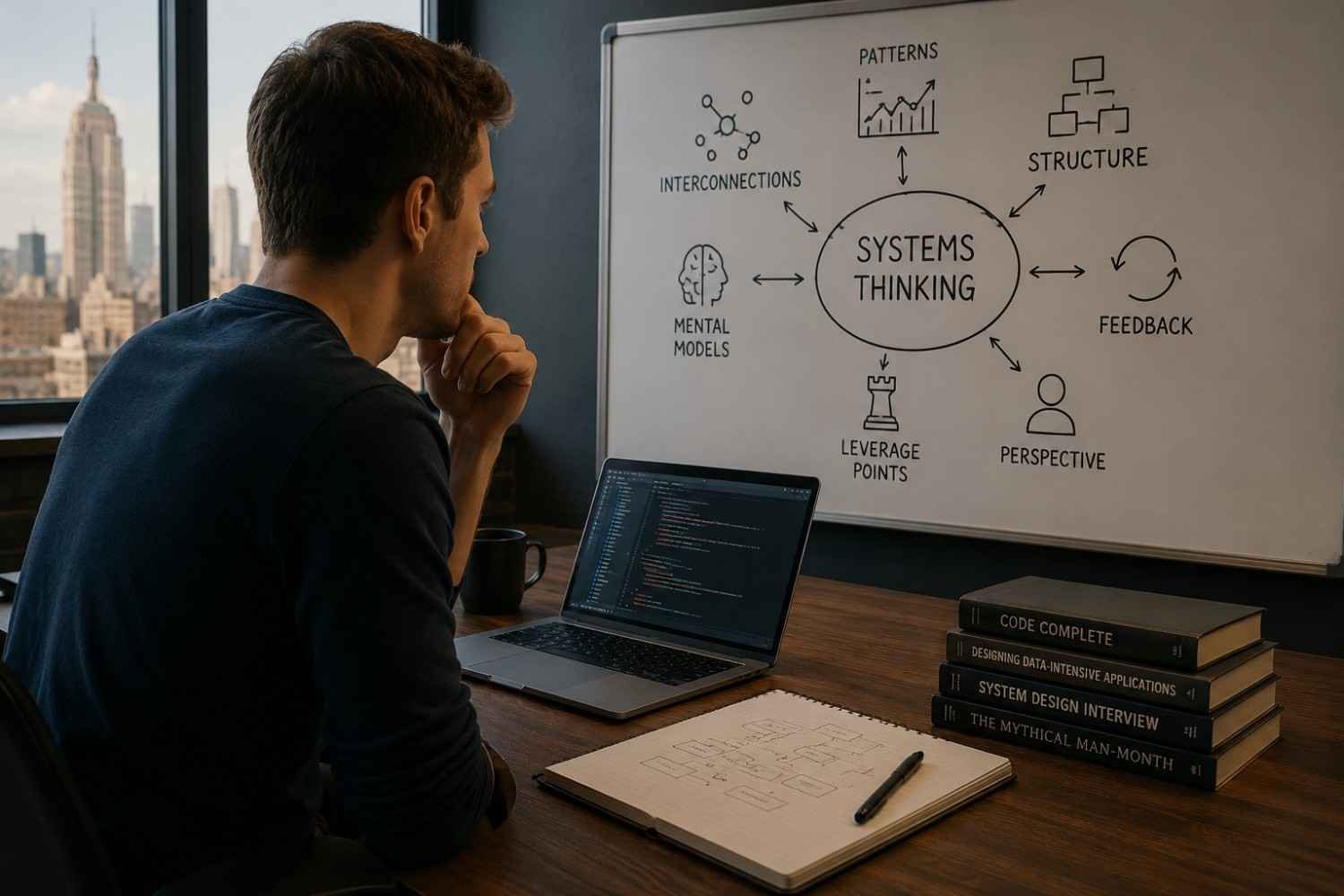
Programming languages and frameworks will continue to evolve. The principles behind scalable software rarely do.
Understanding concepts such as loose coupling, abstraction, observability, feedback loops, reliability, and maintainability allows developers to adapt regardless of the technology stack.
Whether a company uses AWS or Azure, Go or Rust, Kubernetes or traditional servers, systems thinking provides a foundation that transfers across environments.
Instead of becoming an expert in one tool, developers become effective at solving complex engineering problems.
That’s a skill employers continue to value because technology changes much faster than good engineering judgment.
The Shift Happening Across Modern Development
Today’s software teams increasingly expect engineers to understand the entire lifecycle of an application rather than focusing only on writing code.
Developers are shifting their attention in several important ways:
- From writing components to designing scalable systems that handle growth gracefully.
- From isolated coding tasks to understanding how microservices, databases, APIs, and infrastructure influence one another.
- From producing more code to creating software that’s easier to maintain, monitor, and improve over time.
These changes reflect a broader industry move toward engineering decisions that create long-term stability instead of short-term productivity.
AI Is Accelerating This Change

Artificial intelligence isn’t replacing software engineers, but it is changing what makes an engineer valuable.
Many coding assistants can already generate boilerplate code, create API endpoints, write unit tests, and translate code between frameworks within seconds.
Those capabilities reduce the competitive advantage of simply knowing another framework.
What AI still struggles with is evaluating architectural trade-offs, balancing performance with maintainability, identifying hidden dependencies, and understanding business context.
Those responsibilities require systems thinking.
Developers who understand how software behaves at scale can use AI as a productivity tool while continuing to provide the engineering judgment that organizations rely on.
That’s one reason discussions around how AI is reshaping software engineering careers increasingly focus on decision-making rather than coding speed.
How Developers Can Build Systems Thinking
Building systems thinking doesn’t require abandoning programming or learning an entirely new discipline. It starts with becoming more curious about how software behaves outside your editor.
Spend time reading system design case studies instead of only framework documentation. Trace how requests travel through an application. Learn how databases, caching layers, queues, authentication services, and cloud infrastructure interact.
Participating in architecture discussions, reviewing production incidents, and performing root cause analysis also strengthens this mindset. Every outage becomes an opportunity to understand why the system behaved the way it did instead of simply fixing the visible bug.
Over time, these experiences create mental models that remain useful regardless of which programming language or framework becomes popular next.
Why This Shift Will Continue

Frameworks will always have a place because they help developers build software faster. But they’re becoming easier to learn, easier to replace, and increasingly supported by AI-powered tools.
Systems thinking fills the gap that automation cannot easily replace. It helps engineers design resilient applications, communicate across teams, evaluate technical trade-offs, and make decisions that improve software long after the first version ships.
Developers who invest in these skills aren’t ignoring new technologies. They’re building the foundation that allows them to learn any technology faster while making better engineering decisions throughout their careers.
FAQs: Why Developers Are Learning Systems Thinking Instead of More Frameworks
1. What is systems thinking in software engineering?
Systems thinking is the practice of understanding how different parts of an application interact instead of focusing only on individual components or code.
2. Why are developers moving away from learning more frameworks?
Frameworks change quickly, while systems thinking provides long-term skills that apply across technologies and help solve larger engineering challenges.
3. Does systems thinking replace learning frameworks?
No. Developers still need frameworks, but understanding architecture and system behavior creates a stronger foundation for using them effectively.
4. Is systems thinking important for junior developers?
Yes. Developing this mindset early improves debugging, collaboration, and problem-solving while preparing developers for senior engineering responsibilities.
Why Strong Foundations Outlast Popular Tools
Technology will continue to evolve, and new frameworks will keep appearing. The developers who thrive won’t be the ones chasing every trend. They’ll be the ones who understand how software behaves as a complete system, make thoughtful architectural decisions, and solve problems that extend beyond individual lines of code. Those abilities remain valuable no matter how the technology landscape changes.
Frameworks help you build software. Systems thinking helps you build software that lasts.
Leave a Reply